

AI agents | Four approaches
Evaluating agentic access control approaches

Different controls see different parts of the agent action chain
As organizations move agents into production, they are looking for practical ways to control what those agents can access and do at runtime.
In many cases, that means extending technologies they already use across networking, API security, MCP, data security and identity. Each approach brings a different control point, and each covers a different part of the agent action chain.
The question is not whether one of these approaches is useful. It is where that approach enforces control, what context it sees and where its coverage stops.
Different control points. Different visibility. Different coverage.
Four approaches to agentic runtime access control

Network/API-led

MCP-led

Data-led

Identity-led
To compare the different approaches to agentic runtime access control, we’ll evaluate each one against three core requirements.

Session identity and provenance
Can it preserve the originator, agent and downstream agent lineage across the action chain?

Runtime policy enforcement
Can it enforce policy based on the tools, actions and context of the task?

Task-specific authorization
Can it provide short-lived access into the target system instead of relying on standing privileges?
Where each approach enforces control
A typical agent action chain can span: Originator → agent → sub-agent → tool → MCP/A2A → target system
Each approach controls a different part of that path. Network and API controls govern connectivity and transactions. MCP controls govern tool invocation. Data security adds context around the target. Identity establishes who is acting. Authorization determines what access should actually be granted.
Network and API-led approach

Primary control point: connectivity and API transactions
Network and API-led approaches treat agent activity largely as traffic that needs to be inspected, routed and governed.
They can help organizations:
- Restrict which destinations an agent can reach
- Inspect API calls and transactions
- Apply controls at a gateway or network boundary
- Limit connectivity between agents, tools and target systems

Where they fall short
These controls typically do not preserve the full provenance of the originating user and downstream agents. They also stop short of controlling the privileges an agent ultimately exercises inside the target system.
An agent may be allowed to reach a database, for example, while still holding broader permissions inside that database than the task requires.

MCP-led approach
Primary control point: tool access through MCP or agent gateways
MCP-led approaches treat the MCP layer as the key enforcement point between agents and tools.
They can help organizations:
- Discover and govern tools
- Control which agents can invoke which tools
- Apply policy to MCP calls
- Broker credentials
- Centralize agent-to-tool access
Where they fall short
MCP is one point in a longer execution chain. An MCP control may determine whether an agent can call a tool, but it does not necessarily preserve the full originator-to-agent lineage before the call or govern the privileges exercised inside the target system afterward.
Securing the MCP layer is useful. It is not the same as securing the full action chain.

Data-led approach
Primary control point: sensitive data and exposure
Data-led approaches focus on protecting sensitive data as agents access, process and move it across connected systems.
They can help organizations:
- Discover and classify sensitive data and exposure
- Map which users, services and agents can reach sensitive resources
- Inspect data flowing between agents and connected data sources
- Filter or block sensitive content before it leaves controlled boundaries
Where they fall short
These approaches provide strong visibility into the target and the data at risk, but they do not necessarily control the identities and permissions involved across the entire execution chain.
They help answer what is exposed. They do not always answer whether this agent should be allowed to take this specific action right now.

Identity-led approach
Primary control point: the identities and permissions across the action chain.
Identity-led approaches follow the originating identity, agents, sub-agents and credentials involved in a session.
There are two important variants.
Authentication-led
The authentication-led approaches focus on establishing and preserving identity.
They are useful for:
- Identifying agents
- Managing credentials
- Tracking provenance
- Understanding which identities participated in an action
But authentication alone does not determine what an authenticated agent should be allowed to do inside a target system.
Authorization-led
The authorization-led approaches extend identity controls into the runtime permissions and actions of the agent.
They can evaluate:
- Who or what originated the task
- Which agent is acting
- What action is being requested
- Which target is involved
- What permissions are required
- Whether that access should be granted for this task
This is where identity control extends into end-to-end runtime access control.

The solution
P0 takes an authorization-led approach to agentic runtime access control
P0 extends authorization across the full agent action chain, from the originating user through agents, tools and into the target system.
Instead of treating identity, tool access and permissions as separate controls, P0 evaluates them together at runtime.
That means access decisions can reflect who initiated the task, which agent is acting and what it is trying to do, then carry that context into the permissions granted in the target system.
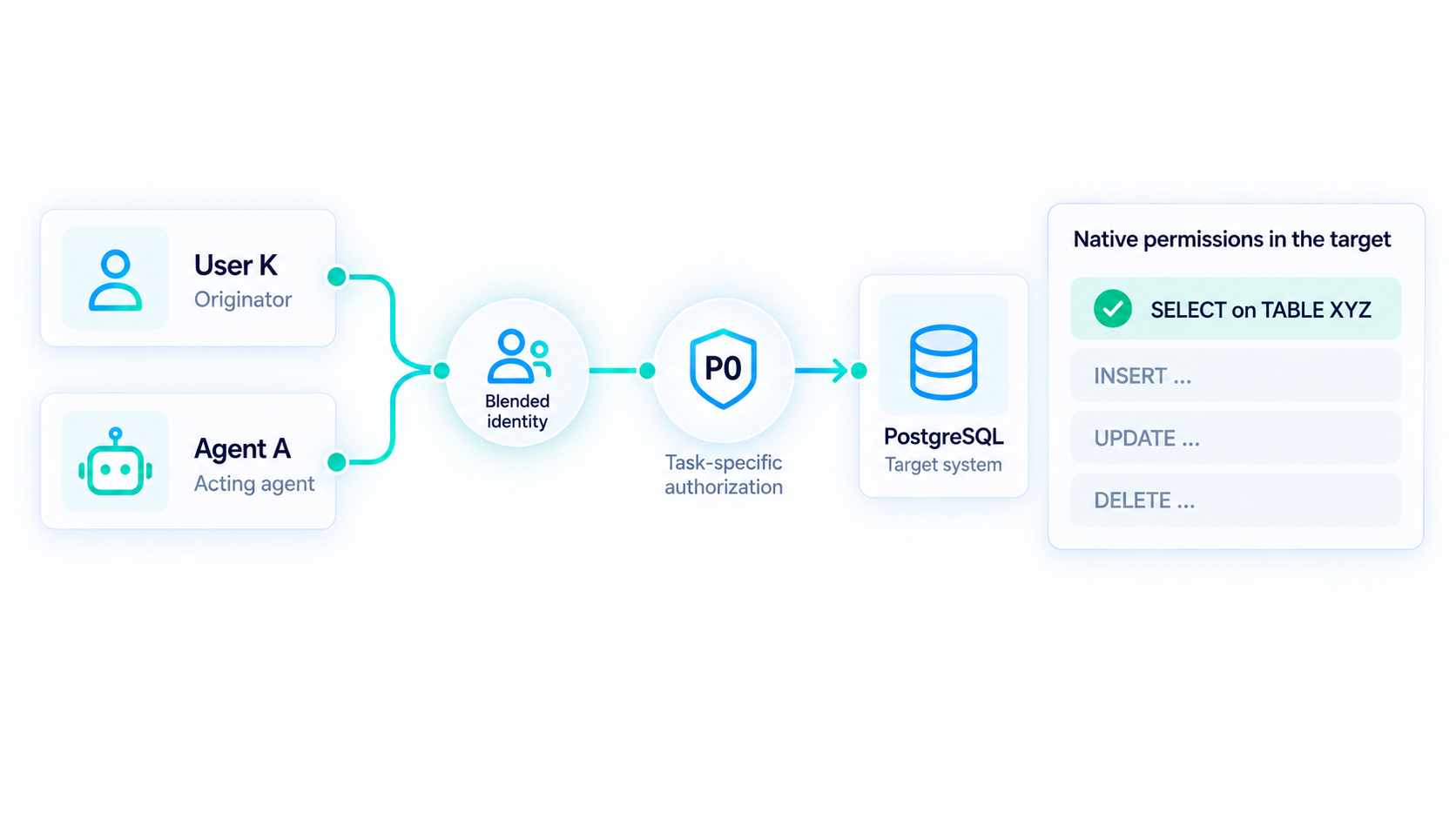
Example: native target-system permissions
P0 can use the blended identity of agent A acting for user K to determine whether that session is allowed a specific native permission, such as SELECT on TABLE XYZ in PostgreSQL.
The decision applies inside the target system, not just at the tool or gateway layer.
Unique session identity and provenance
Runtime policy enforcement across agent and tool activity