

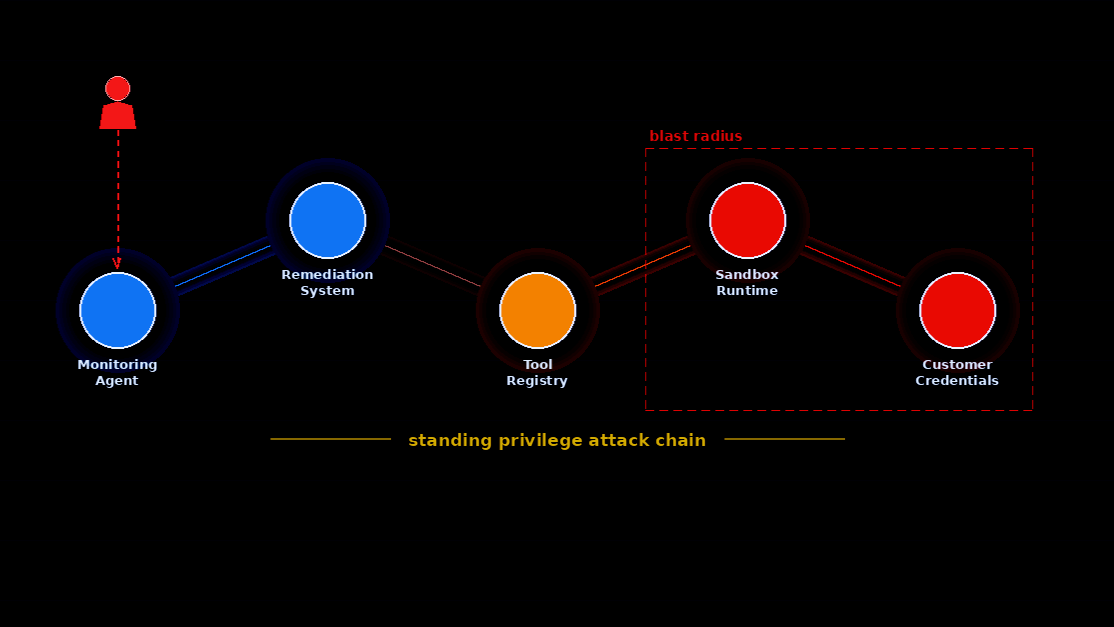
Composio disclosed a security incident on May 21. The security incident report describes how an attacker reached a foothold in an internal agentic tool monitoring Composio’s infrastructure, escalated through the automated remediation systems that fix errors in their connectors, registered malicious tool definitions in the platform’s sandbox and ended with arbitrary code execution in Composio’s tool-execution sandbox.
The important lesson is not that an agentic system was involved. It is that internal automation had enough standing authority to become an attack path. Once the attacker found a way to drive that automation, the platform’s own trusted workflows carried the breach forward.
While the incident report highlights that the full list of leaked connections was only 0.3% of total active connections, the disclosed impact still included roughly 5,000 GitHub OAuth grants and 5,241 cached API keys that Composio assesses were “likely” exposed. A leaked internal GitHub token also prompted Composio to obfuscate the production codebase.
The dangerous part was not the sandbox, it was the ungoverned path into it
The breach chain Composio describes runs entirely inside their own boundary. A monitoring agent for connectors was abused into facilitating the next elevated access step. Whether the agent itself was reasoned into invoking remediation functions, or whether the foothold gave the attacker a separate path into a neighboring remediation system, is not clear from the public bulletin.
Regardless, the monitoring surface was supposed to observe. The remediation surface was supposed to fix. But once those systems were connected with enough privilege between them, observation became a path to destructive action. From there, the attacker registered malicious tool definitions in Composio’s sandboxed execution environment and was able to run arbitrary code in the runtime where customer-scoped tool calls execute.
The chain matters more than the entry point. While the bulletin notes the attacker showed “deep knowledge of our API surface and internal architecture” and was “likely augmented by advanced AI systems,” that changes the timeline of an attack but not the control failure. The systems the attacker traversed were already in place, already wired together, and already held the privilege the attacker exercised through them.
Same failure, different driver
Neha, our CPO, recently covered control failures of this kind, where standing privileges held by an agent led to a production incident on the agent’s own initiative. The Composio case is the other side of that coin: an attacker purposefully abused the agent rather than the agent going wrong on its own. The underlying failure is the same. Any internal automation surface with broad standing privilege becomes dangerous once someone else can drive it. It does not matter whether that “someone” is a confused agent, a compromised workflow or an attacker with deep knowledge of the platform. The blast radius is defined by the standing privileges already sitting there.
This is the uncomfortable part for agentic platforms. It is not enough to ask whether the agent, tool or sandbox is secure in isolation. The real question is what each system is allowed to do at runtime, how that permission is granted, how long it lasts and whether the action is authorized in the context of the customer, credential or connector being touched. Without that critical control layer, internal tools become trusted shortcuts through the very boundaries they were meant to protect.
What this means in practice
For operators of agentic platforms: assume an internal-automation compromise is a likely entry point and design around it. Separate trust zones between observation and action. Require per-action authorization for changes that touch customer credentials. Keep an audit trail clear enough that a post-incident reader can tell from outside the platform which kind of escalation occurred. For buyers of agentic tool platforms: the platform holds enough on your behalf that its own internal pivots belong in your threat model.
Composio is being commendably transparent in their disclosure, and the chain they describe is worth examining carefully against your own architecture.
Short post:
The Composio breach was not only about agentic AI, leaked credentials or sandbox execution. It was about trusted internal systems with enough standing privilege to become an attack path.
Frequently asked questions
What did the Composio breach reveal about AI agent and access security?
The Composio breach revealed that AI agent and access security incidents typically trace back to over-permissioned integrations rather than the agent’s behavior itself.
Why do agentic security incidents usually trace back to access design, not the agents?
Agentic security incidents usually trace back to access design, not the agents, because a compromised or misused agent can only do what its permissions allow.
How could least-privilege, just-in-time access have limited the breach impact?
Least-privilege, just-in-time access could have limited the breach impact by scoping the compromised integration’s permissions to only its specific task.
How does P0 Security reduce the blast radius of compromised AI agents and integrations?
P0 Security reduces the blast radius of compromised AI agents and integrations by enforcing runtime authorization that limits every action to what’s actually needed.