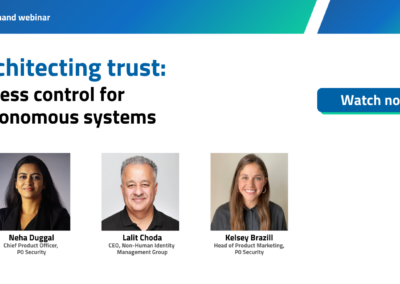
Autonomous agents assume trust and gain access fast. Learn how to govern them with the right policies so they stay productive, contained and out of sensitive systems.
Vault-centric PAM breaks in modern environments and adds risk and drag. This guide shows what to require instead, with identity-native controls and just-in-time access across all identities.
NHIs power cloud, CI/CD and Kubernetes but create a fast-growing attack surface. Learn how to control them with just-enough, just-in-time access, monitoring and lifecycle governance.
Non-human identities run with persistent permissions and expand your attack surface. Learn how to replace just-in-case access with just-enough, just-in-time controls and real monitoring.
IAM, IGA and PAM struggle with today’s complex identity sprawl. This interview shows why they break and how teams can rethink identity security for modern environments.
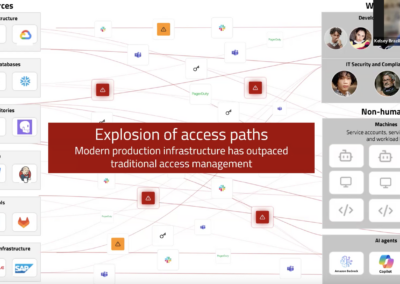
New infrastructure and identities are outpacing legacy security models. This session gives a first-principles framework to rethink identity security and plan next steps.
New infrastructure and identities are outpacing legacy security models. This session gives a first-principles framework to rethink identity security and plan next steps.
Agentic AI systems run with broad, always-on permissions and no oversight. This session shows how to govern autonomous access with modern policies that reduce risk without slowing agents down.
A quick look at P0’s privileged access control plane which automates least-privilege, removes standing access and provides unified governance for users, workloads and agents across hybrid and multi-cloud environments.
In Part 4 of our Non-Human Identity (NHI) Governance series, Kelsey Brazill explains why this blind spot persists, and what good governance really looks like when extended to machines.
In Part 3 of our Non-Human Identity (NHI) Governance series, Kelsey Brazill breaks down why vaulting isn’t enough, what true governance looks like, and how to move from static credentials to ephemeral, just-in-time access.